
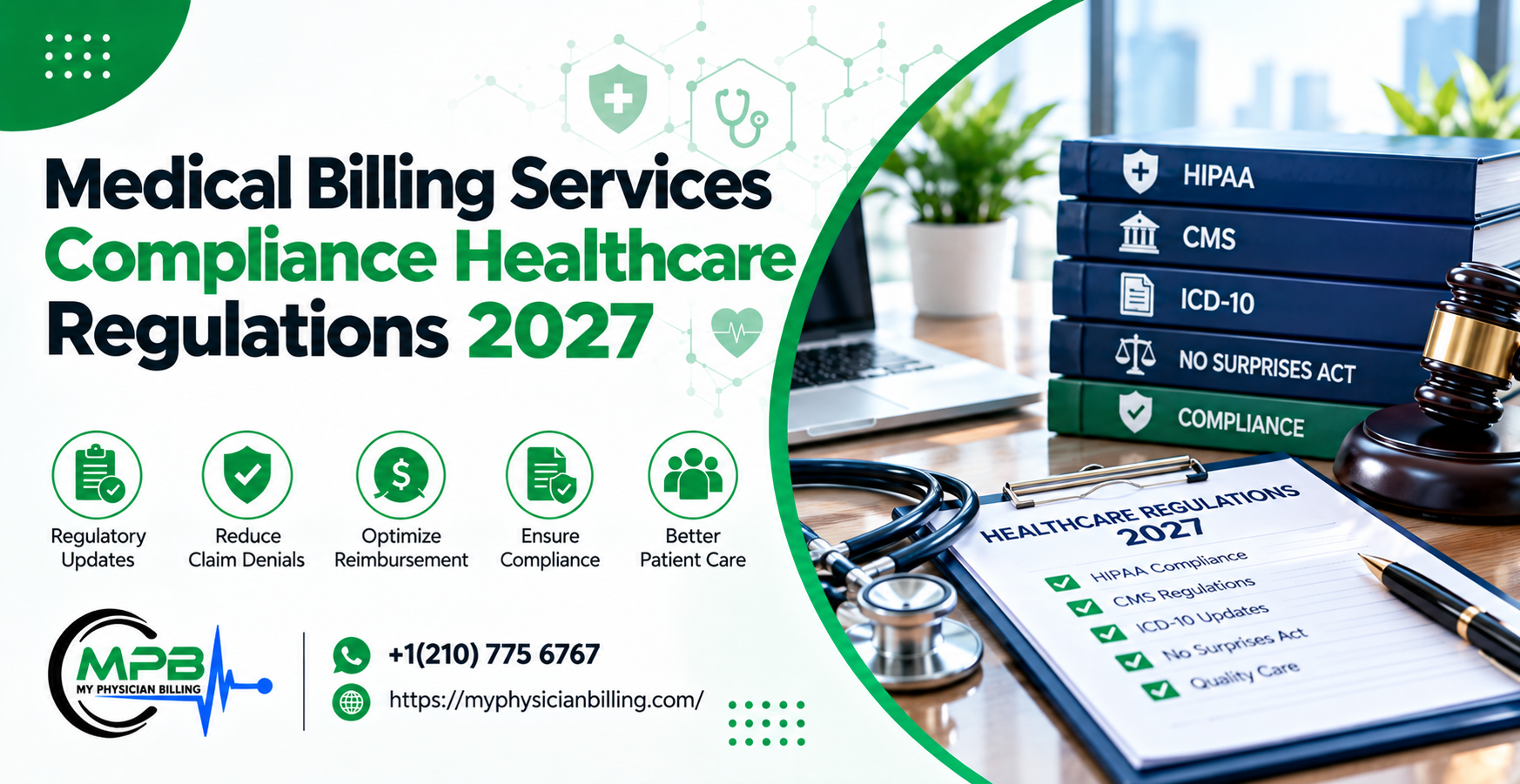
Medical Billing Services Compliance Healthcare Regulations 2027
Medical billing compliance is entering a new era in 2027. With federal agencies increasing audit activity and payers tightening reimbursement rules, medical practices can no longer afford to treat compliance as an afterthought. For providers, staying updated with healthcare regulations in 2027 is now directly linked to revenue protection, audit prevention, and long-term operational stability.
From updated coding standards to new transparency requirements, the regulatory landscape is evolving faster than ever. Practices that adapt early will see fewer denials, faster payments, and stronger payer relationships. This is where expert partners like My Physician Billing, offering Medical Billing Services in Texas and Medical Billing Services in California, help practices stay compliant while maintaining healthy cash flow.
Why Compliance Is More Critical Than Ever in 2027
Compliance is not just about avoiding penalties. It impacts every part of your revenue cycle.
In 2027, the Office of Inspector General (OIG) and the Centers for Medicare and Medicaid Services (CMS) are using advanced artificial intelligence to detect billing errors, upcoding, and unusual billing patterns. Even unintentional errors can trigger audits and repayment demands. A single non-compliant claim can lead to claim rejections, delayed payments, and potential exclusion from federal payer programs.
Compliant billing ensures that every service billed is medically necessary, properly documented, and coded according to the most current guidelines. It builds trust with payers and protects your practice from financial and legal risks.
Major Healthcare Regulatory Updates Affecting Medical Billing in 2027
Updated CMS Final Rule for Physician Payments
The CMS Final Rule for 2027 introduces important changes to the Medicare Physician Fee Schedule. There is a stronger focus on value-based care, primary care reimbursement adjustments, and stricter documentation for evaluation and management services. Practices must ensure time-based billing and medical decision making are clearly documented to support the level of service billed.
Enhanced No Surprises Act Enforcement
The No Surprises Act enforcement is stricter in 2027. Medical billing services must provide clear good faith estimates for self-pay patients, enhanced patient consent documentation, and accurate provider directory information. Failure to comply can result in significant financial penalties and loss of payer contracts.
New Information Blocking and Interoperability Requirements
Information sharing rules have expanded. Billing systems must now be fully interoperable with electronic health records and must support real-time access to billing and payment information for patients. Medical practices must review their technology vendors to ensure compliance with updated interoperability standards.
Changes to HIPAA Security and Privacy Safeguards
HIPAA compliance requirements have been modernized for 2027. There are new requirements for multi-factor authentication, end-to-end encryption for patient billing data, and shorter breach notification timelines. Billing companies that handle protected health information must undergo regular security risk assessments and maintain detailed audit logs. Practices looking for Medical Billing Services in Texas should confirm that their vendor already meets these safeguards.
ICD 11 Transition and Coding Accuracy
While ICD-10 is still in use in the United States, CMS has released preparatory guidelines for ICD-11 adoption. Coding accuracy expectations have increased significantly. Payers in 2027 are denying claims with unspecified codes more frequently than ever before. Detailed clinical documentation improvement programs are now essential.
How Compliant Medical Billing Services Protect Your Practice
Partnering with a compliance-focused billing service provides multiple layers of protection.
First, it ensures continuous coding education. Certified coders stay updated with annual CPT, HCPCS, and ICD changes.
Second, it includes internal auditing. Leading billing services conduct monthly internal audits to identify error patterns before payers do.
Third, it improves documentation. Compliance-focused billing teams work with providers to ensure clinical notes support every code billed.
A professional approach to medical billing compliance not only prevents audits but also increases clean claim rates. When documentation and coding align perfectly, denials drop and reimbursements accelerate.
Many successful practices, including those that need Medical Billing Services in California, rely on My Physician Billing to implement these compliance-first processes without burdening their internal staff.
Key Steps to Ensure Compliance in 2027
Conduct Regular Compliance Risk Assessments
Every practice should conduct a comprehensive compliance risk assessment at least twice a year. This includes reviewing coding accuracy, modifier usage, and medical necessity documentation.
Invest in Staff Training and Certification
All billing staff should be certified and receive quarterly training on new regulations. Training should cover CMS updates, payer-specific policies, and fraud, waste, and abuse prevention.
Implement Advanced Technology and Automation
In 2027, manual billing is a major compliance risk. Automated claim scrubbing tools, artificial intelligence-powered coding validation, and real-time eligibility verification help reduce human error and ensure every claim meets payer and federal requirements.
Maintain Transparent Patient Financial Communication
New regulations emphasize patient financial transparency. Practices must provide upfront cost estimates, clear statements, and easy access to billing support. This reduces patient complaints and helps meet surprise billing compliance.
Keep Detailed Audit Trails
Maintain complete records of all billing activities, payer communications, and coding changes. In case of an audit, a well-documented audit trail can be your strongest defense.
Conclusion
Medical billing compliance in 2027 is more complex, more technology-driven, and more closely monitored than ever before. Regulatory changes from CMS, OIG, and federal transparency laws mean that practices must move from reactive billing to proactive compliance management.
Staying compliant requires continuous education, strong technology, regular audits, and a deep understanding of evolving payer rules. For practices that want to focus on patient care while staying fully protected, working with a specialized partner that offers Medical Billing Services in Texas and Medical Billing Services in California is the smartest path forward.
With a dedicated compliance-driven approach, My Physician Billing helps practices navigate the new regulatory environment with confidence and financial stability.
FAQs
The biggest changes include stricter enforcement of the No Surprises Act, the updated CMS Final Rule for physician payments, enhanced HIPAA security requirements, and increased use of artificial intelligence by payers to detect billing errors and upcoding.
Practices can avoid audits by ensuring accurate clinical documentation, using specific codes instead of unspecified codes, conducting regular internal billing audits, providing ongoing staff training, and implementing automated claim scrubbing tools.
Yes. In 2027, HIPAA rules require multi-factor authentication for all systems that store protected health information, stronger encryption standards, and faster breach notification timelines. Billing services must also maintain detailed access logs and complete annual security risk assessments.
Non-compliance can lead to claim denials, delayed reimbursements, repayment demands, financial penalties, increased audit risk, and in serious cases exclusion from Medicare and Medicaid programs.
A compliance plan should be reviewed and updated at least every six months and immediately after any major CMS rule release, payer policy change, or coding update to ensure alignment with current healthcare regulations.

Comments are closed