
MIPS Audit Assistance Chicago How Practices Stay Compliant and Protect Payments
MIPS audit assistance Chicago providers rely on helps practices collect, verify, and organize the documentation CMS may request to prove their Merit-based Incentive Payment System (MIPS) data. It covers readiness reviews, evidence gathering, and response preparation, so a practice avoids penalties and keeps its earned payment adjustments.
Medicare reporting is no longer a once-a-year checkbox. From solo clinics to multi-specialty groups across the Loop, Lincoln Park, and the suburbs, providers now face data validation requests that can reach back several years. A structured approach turns that pressure into a manageable, repeatable process.
MIPS Audit Assistance Chicago: Why It Matters
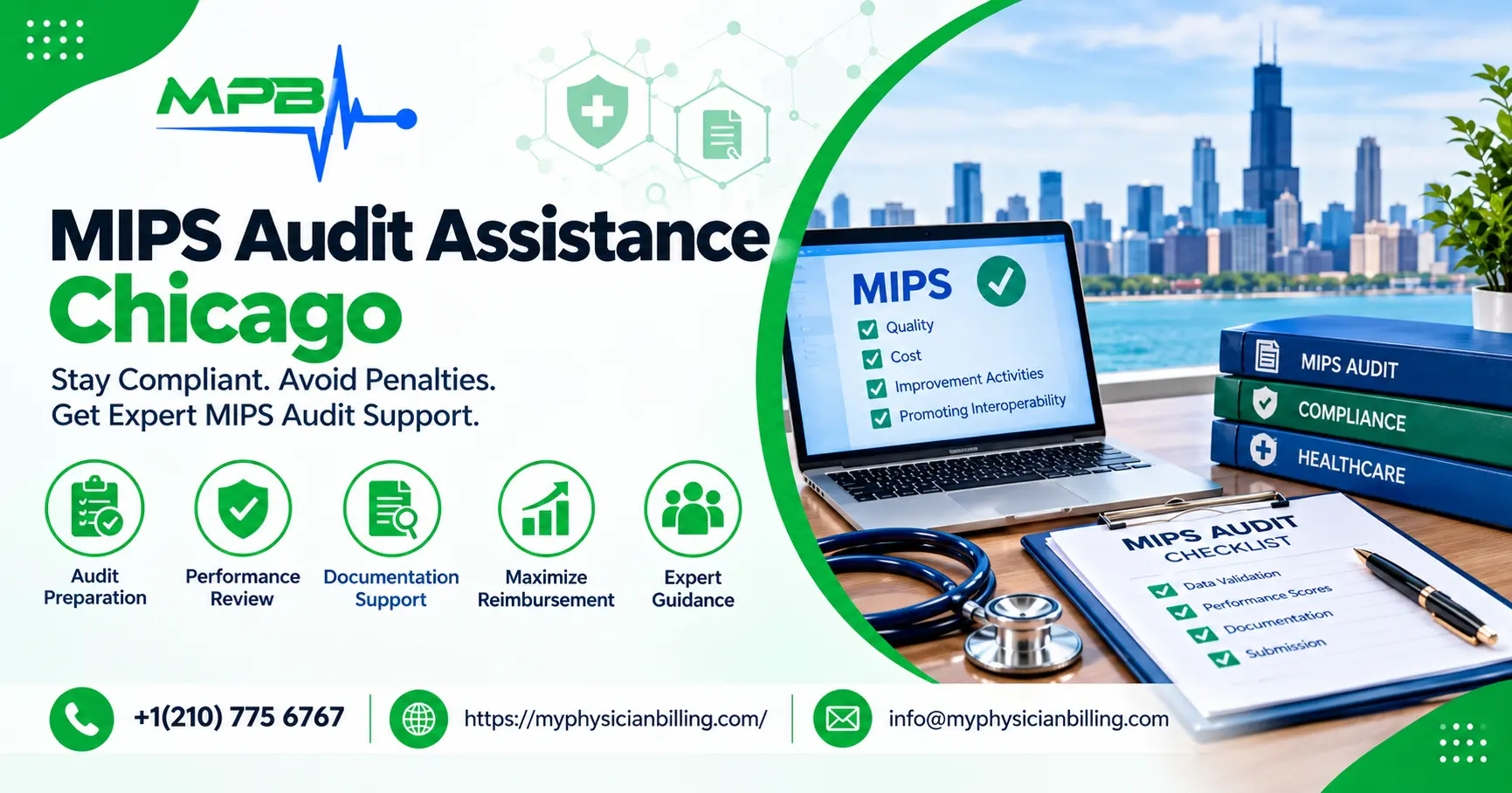
MIPS adjusts Medicare Part B payments based on performance across four categories: Quality, Cost, Promoting Interoperability, and Improvement Activities. Adjustments can reach up to 9 percent in either direction, so a failed validation is costly. CMS and its contractors can ask clinicians to prove that submitted data is accurate, and providers are expected to keep supporting records for six years. Without organized documentation, even a high-performing practice can lose points or face a payment reversal.
Audit support generally covers three areas:
- Preparation: reviewing submitted measures and attestations against source records.
- Documentation: building an evidence file for each category.
- Response: drafting complete answers to CMS within deadlines.
Why Do Local Practices Need Specialized Support?
Illinois providers work across hospital systems, independent groups, and telehealth models. Each uses different EHR platforms, registries, and reporting methods. A one-size-fits-all approach leaves gaps such as mismatched attestation dates, missing security reviews, or unsupported improvement activities. Local, hands-on Chicago MIPS audit assistance matches support to your EHR, specialty, and reporting structure, and it trains staff on documentation habits that survive review.
Common Triggers for a MIPS Data Validation Request
Audits are not always random. These issues commonly raise questions:
- Reported numerators that do not match EHR reports
- A missing or outdated security risk analysis
- Improvement activities with no proof of completion
- Group reporting that includes clinicians who left the practice
- Exclusions or hardship claims without supporting records
MIPS Audit-Readiness Checklist by Category
Use this table as a quick reference when organizing evidence for each performance year.
| MIPS Category | Documents to Keep | Common Audit Risk | Retention |
|---|---|---|---|
| Quality | EHR or registry reports, measure specifications, patient lists | Numerator and denominator mismatch | 6 years |
| Promoting Interoperability | Security risk analysis, attestation records, EHR certification proof | Missing or outdated risk analysis | 6 years |
| Improvement Activities | Logs, sign-in sheets, protocols, completion certificates | No proof of the 90-day activity | 6 years |
| Cost | CMS claims-based feedback reports | Misunderstanding attribution | 6 years |
| Group Reporting | TIN and NPI rosters, participation agreements | Clinicians listed who have left | 6 years |
How Does the MIPS Audit Support Process Work?
A structured process, the backbone of any Chicago MIPS audit assistance engagement, lowers risk and saves staff hours.
- Gap assessment. Compare your submitted data with your source records.
- Evidence organization. Build one indexed folder per performance year and category.
- Corrective action. Fix workflow problems, such as undocumented screenings or expired reviews.
- Response preparation. Draft concise, complete replies if CMS requests validation.
- Ongoing monitoring. Review documentation quarterly rather than annually.
Practices that follow this routine usually find that audit requests become far less stressful. Staff know where each record lives, providers understand which measures carry the most risk, and leadership can see exactly how reported performance ties back to patient encounters. That visibility also supports better decisions during the next reporting year, from selecting measures to scheduling improvement activities early enough to document them properly.
Choosing MIPS Audit Assistance Chicago Practices Can Trust
The right partner understands both clinical reporting and the revenue cycle. Look for these traits:
- Documented experience with CMS validation requests
- Knowledge of your EHR and registry connections
- Clear timelines and transparent reporting
- Support that continues beyond a single audit
Many groups prefer MIPS audit assistance Chicago clinics can trust because it blends compliance review with billing expertise. At My Physician Billing, audit readiness is built into the wider billing workflow, so performance data, claims, and documentation stay consistent.
How Does Audit Readiness Connect to Your Revenue Cycle?
MIPS performance does not exist apart from billing. Inaccurate coding, rejected claims, or incomplete provider records can hurt your quality data and your payment adjustment. Groups operating in several states benefit from consistent standards. Understanding how medical billing in Texas differs from Medical Billing in California helps them apply the same documentation discipline everywhere.
Accurate provider enrollment also matters, because incorrect Credentialing data can cause attribution and reporting errors. A current HIPAA security risk analysis is also one of the most requested records in any review. Finally, strong Denial management protects the revenue that your MIPS performance earns.
Frequently Asked Questions
1. What does MIPS audit assistance Chicago providers receive include?
MIPS audit assistance Chicago practices receive typically includes a documentation review, a gap analysis across all four performance categories, an organized evidence file, and help writing responses to CMS validation requests. Many providers also receive staff training on documentation habits.
2. How long should a practice keep MIPS records?
CMS expects clinicians to retain MIPS data and supporting documentation for six years. Keeping records indexed by performance year and category makes retrieval much faster during a validation request.
3. What happens if a practice fails a MIPS audit?
If CMS cannot validate submitted data, the practice may lose points, and its payment adjustment can be changed or reversed. Early preparation reduces this risk, and a targeted review may be available if you disagree with your final score.
4. Is MIPS audit support only for large groups?
No. Solo clinicians and small groups face the same documentation expectations as large systems, and they often have fewer staff to manage them. Chicago MIPS audit assistance scales to fit practices of any size.
5. Why choose a billing partner for audit readiness?
My Physician Billing connects compliance support with claims, coding, and revenue cycle expertise. This means your reported data, billing records, and documentation tell one consistent story if CMS asks for proof.

Comments are closed